The Value of a Stone: Its Features or the Story?
The documentation behind each stone’s associated story
By Thomas S. Elias
A rock can become an exceptional viewing stone due to its unique features or the story associated with it. In rare circumstances, both the stone’s phenotype and a memorable story can combine to make it a notable part of the modern history of viewing stone appreciation. The documentation behind each stone’s associated story is, unfortunately, often lost over time. But not always. This article provides the documentation behind an extraordinary gift.
In February, 2002, Mr. Saburo Kato presented me with a red Kamo River susieki during our visit to his Mansei-en bonsai nursery in Omiya, Japan. This was a special occasion because I received this unexpected gift from the chairman of the Nippon Bonsai Association. We had been working closely together on several important projects over the previous five years. At that time, I was serving in the Senior Executive Service of the U.S. Department of Agriculture, and as Director of the U.S. National Arboretum.
This Kamo River Kibune stone is only 13 x 10.5 x 17 cm and comes with an exquisitely made understated hardwood base, and a Japanese style storage box (kiro-baki) made from Paulownia wood. This stone matched the personality of Mr. Kato. He was not showy or flamboyant, nor was he arrogant. The thin spry Kato was a quiet, serious man who had a deeply abiding love of bonsai, and spoke with intense personal feelings about his love for bonsai.
I had met with Saburo Kato during my earlier visits to Tokyo. We discussed how to further improve the collection of Japanese bonsai at the National Bonsai and Penjing Museum at the U.S. National Arboretum in Washington, D.C. Together with the National Bonsai Foundation’s generous support and cooperation, a new gift of seven large exceptional bonsai was presented as a government-to-government gift with the understanding that they would become part of the collection in the Museum. On April 3rd, 1998 the bonsai were formally presented in Washington, DC.
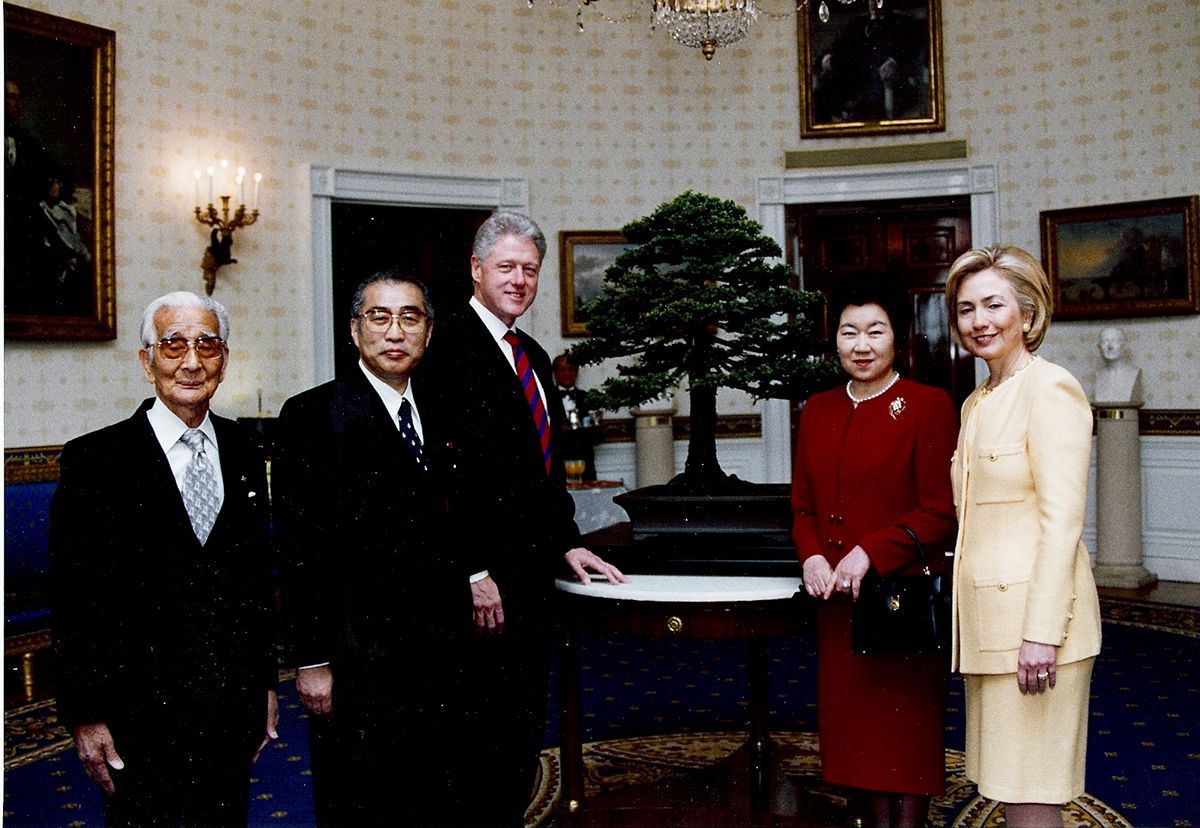
U.S. president, William J. Clinton, was invited to Japan for an official head of state meeting with Japanese Prime Minster Obuchi. On November, I received an urgent letter from Saburo Kato informing me that Prime Minter Obuchi was considering presenting President Clinton with two bonsai and a suiseki to commemorate the President’s visit later that month. He asked me to assist in facilitating this gift. I was able to convince a key White House staff member to recommend accepting the gift, especial since the National Arboretum and bonsai museum would receive and care for these exceptional valuable bonsai specimens. During his visit to Japan Clinton invited Prime Minister Obuchi to come to Washington for a reciprocal visit in May, 1999.
With Secretary of Agriculture Dan Glickman approval, I proposed to The White House staff the ideal of President Clinton presenting a gift of an outstanding American bonsai and a viewing stone to Prime Minster Obuchi. Felix Laughlin, President of the National Bonsai Foundation, was able to obtain a donation of an impressive California juniper and an Eel River viewing stone. My proposal met resistance as not being appropriate until I gained an ally in the White House and pointed out that Obuchi practiced the art of bonsai, and that Saburo Kato was his teacher. Eventually, the opposition was overcome, and the Department of State agreed. The presentation took place on May 2, 1999. During Obuchi’s visit, we displayed the bonsai at the official guest house for visiting heads of state, The Blair House. We also were able to displayed bonsai in the White House Blue Room and adjoining hallway for the meeting and dinner at The White House.
Following this momentous occasion, I continued to met with Kato and interviewed him twice for a two-part article I wrote about Mansei-en and the Kato Family that appeared in Bonsai Magazine in late 1999. Saburo Kato and I forged a bond during this time, and we remained friends until his death.
The relationship with Kato and Prime Minster Obuchi and myself was further strengthened on February 14, 2000 when I presented Obuchi with a second America viewing stone. Mr. Kato had arranged the meeting at the Tokyo Metropolitan Art Museum. Both Kato and I were keenly aware that these events contributed to raising a greater awareness of bonsai and viewing stones in the national and international arenas.
Later, Saburo Kato presented me with a scroll he had made to go with the red Kamo River stone. The main characters reads “Way to Peace” The large character in the center translates “Way,” and the smaller characters in the upper right translates “to peace.” The name 'Mansei' and seal are on the lower left. This “Way to Peace” stone and scroll will be on exhibit at the 63rd Meihenten at the Tokyo Metropolitan Art Museum from February 13-16, 2026.
Kato’s gift stone does not have the expressive and explicit features of a waterfall stone or a mountain stone with dramatically rising peaks or similar suiseki that appeal to many western stone collectors. Kato identified it as a dansekior stepstone. Some may consider this as an ordinary rock lacking distinctive features. But, when I look at this stone, I see many fine details in the shape, texture, and quiet colors of this understated beauty of this landscape stone. For me, the value and importance of this stone is the story of our working together, often behind the scenes, to make these high-level gift exchanges a reality.
__________________
Elias, Thomas S. 1999. The Role of Bonsai in the U.S.—Japan Diplomacy.
Bonsai Magazine 38(6): 28-33. 1999.
California Bonsai at The White House and Blair House. Golden Statements. 22(5):36-41.2001.
Mansei-en and The Kato Family. Bonsai Magazine. Part 1, 40(3): 16-18. Part 2, 40 (4): 10-13.
National Bonsai Foundation. Summer 1998. NBF Bulletin. Bonsai/Suiseki Diplomacy. Pages 1, 2.