
Stone and Scene: A Unique Exhibition Where Stones and Art Meet
An extraordinary exhibition of California landscape paintings paired with viewing stones with shared similarities
By Richard Turner and Thomas S. Elias
A unique exhibition of viewing stones and California scene paintings recently opened at the Hilbert Museum of California Art in Orange, California. It is a groundbreaking exhibit that is a must-see for anyone interested in contemporary viewing stone display. Why? Because it begins the conversation between viewing stone appreciation and the fine arts. Because it introduces viewing stones to an entirely new audience that is responding enthusiastically to the unexpected presence of stones in a museum, and is fascinated by how viewing stones makes them rethink the paintings themselves.
The exhibition is also important because it is a model for future exhibitions of viewing stones. Its unique format is an idea that stone appreciation groups might adapt for their annual exhibitions by including paintings and photography by local artists paired with selected stones. Museums elsewhere could mount similar exhibitions, working with local viewing stone collectors and using the resources of their own permanent collections.
The exhibition, in its current form, could travel to other institutions in North America and elsewhere. The lengthy run of the show (seven months compared to the usual week-or-less run of most stone shows) affords the opportunity for large numbers of people to discover the allure of viewing stones.
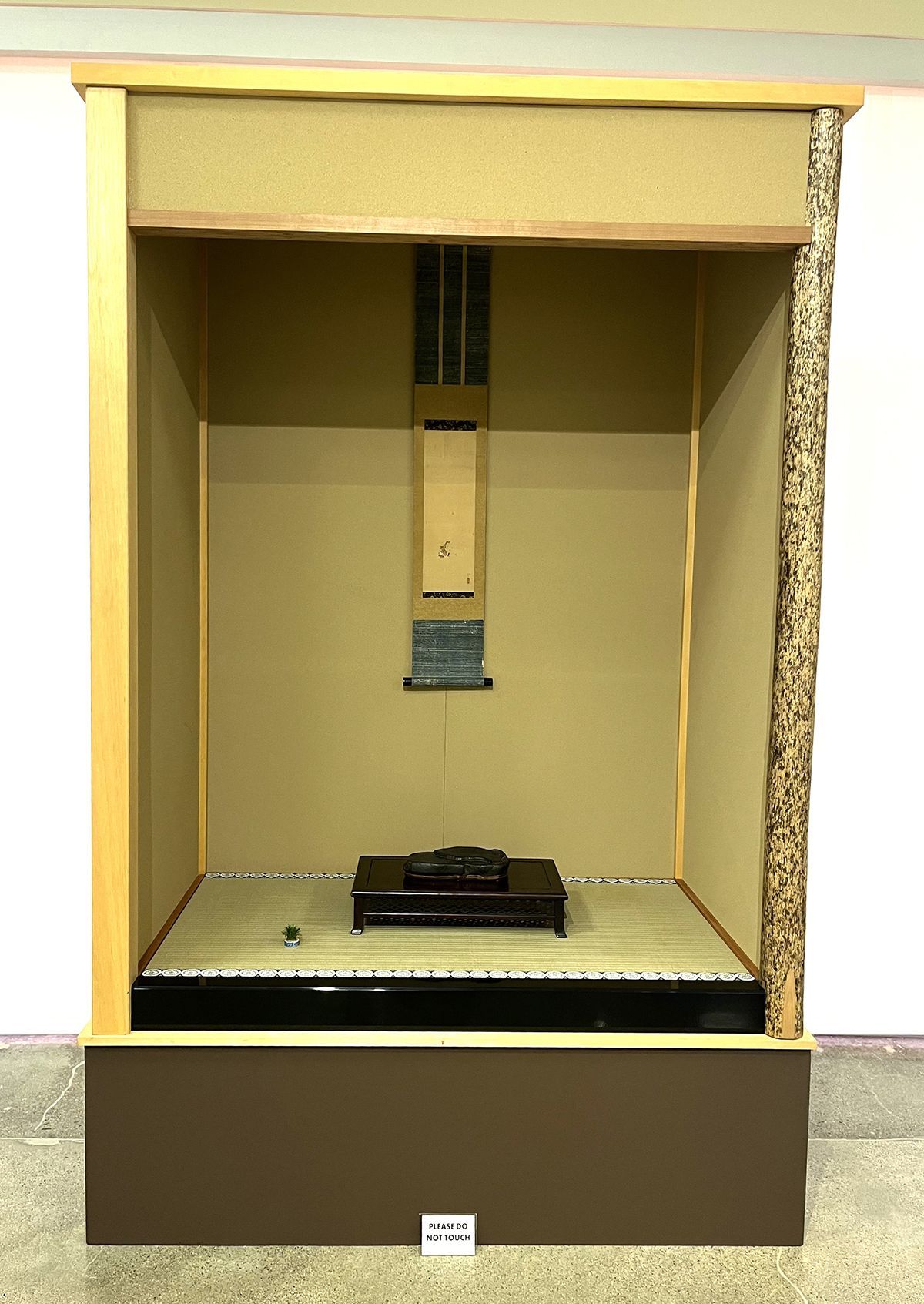
Stone and Scene, curated by Richard Turner, is inspired by the Japanese practice of pairing viewing stones with scrolls in a tokonoma, which is an alcove in a traditional Japanese home used for displaying ikebana, bonsai, and suiseki accompanied by a scroll.
The exhibition proposes a new way of exhibiting viewing stones that is rooted in Japanese tradition and, at the same time, embraces the evolution 21st century stone collection and display. Associating North American stones with paintings of the mountains and deserts in which the stones might have been collected celebrates the distinct geology of the material and the art of the larger culture as well. The relation between a stone suggests a desert mountain range and an oil painting of a prospector and his pack animals is analogous to that of a Japanese brush and ink painting of two frogs paired with a smooth, flat river stone on which the frogs might be imagined sunning themselves. The difference is that the grizzled prospector and his burros are integral to the romance of the American West. The pairing has a resonance that local audiences intuitively understand. Appreciation is not dependent on a familiarity with Japanese poetry, painting and
suisekiaesthetics.
Stones and paintings in the gallery are displayed together for different reasons. Some pairings are easily understandable. One wall takes the visitor on a journey from California’s mountains and across the desert to the seashore. The painting of the bristlecone pine (Methuselah, the oldest living thing on the planet) is an obvious and appropriate companion for the petrified wood on the stand in the corner. Other juxtapositions are deliberately ambiguous. The surreal landscape depicted in the painting hung high on the gallery wall shares the gaudy drama and the color palette of the Lingbi stone on the pedestal below. Tidal Shelves, an installation by Paul Harris that was created in response to watercolors by artist Phil Dike, evokes an outcrop of coastal rocks crusted with shells and hollowed by boring clams, where perching birds watch over nested eggs.
The exhibition also recognizes that the artists who painted the landscapes and the people who collected the viewing stones on display have some surprising things in common. Those of us who caravan out to the desert in our four-wheel drive SUVs in search of stones are not that different from painters such as Conrad Buff and Maynard Dixon, who in the 1920s traveled the Southwest together in a Model T Ford in pursuit of spectacular landscapes. Whether you’re a celebrated artist or an impassioned rockhound, your goal is to somehow capture the essence of your encounter with the landscape. In the case of the California scene painters, it is an image. For the viewing stone enthusiast, it is a rock.
Stone and Scene runs from February 7 to October 4, 2026. The Hilbert Museum of California Art, 167 North Atchison Street, Old Towne Orange, California. The museum is open Wednesday through Sunday 10:00 am to 5:00 pm. http://www.hilbertmuseum.org.