Korean Flower Pattern Stones
An introduction to Korean Flower Pattern Stones
By Thomas S. Elias
Chrysanthemum flowers are highly esteemed in temperate Asian societies and serve as symbols for autumn and for an easier life in retirement. It is not surprising that mineral formations in rocks resembling chrysanthemums and other flowers are prized for their beauty and permanence. In China, they are known as
Juhuashi
(菊花石); in Japan, they are called
Kiku-ishi (菊石) or
Kikka-seki
(菊花石); and in Korea, they are known as
Hwamunseok
(화문석, 花紋石). While the Chinese and Japanese chrysanthemum flower stones are well known among the global viewing stone communities, the Korean flower pattern stones are less familiar to us.
The Korean Hwamunseok were only recently discovered in the early 1970s, mainly in Cheongsong County, North Gyeongsang Province, and PyeongChang County, Gangwon Province. Once mined, these stones are typically ground and polished to reveal intricate mineral patterns beneath the surface. Their Chinese counterparts were known in the mid to late Qing dynasty, and the Japanese flower stones from the late Edo Period.
Many serious Korean collectors only include natural, unworked stones in their definition of
Suseok, stones collected for their aesthetic qualities. Since the Korean flower-patterned stones are worked (ground and polished) to reveal their inner beauty, they are not considered as
Suseok. Because of their rarity and beauty,
Hwamunseok are often included in regional and national exhibitions of viewing stones in Korea.
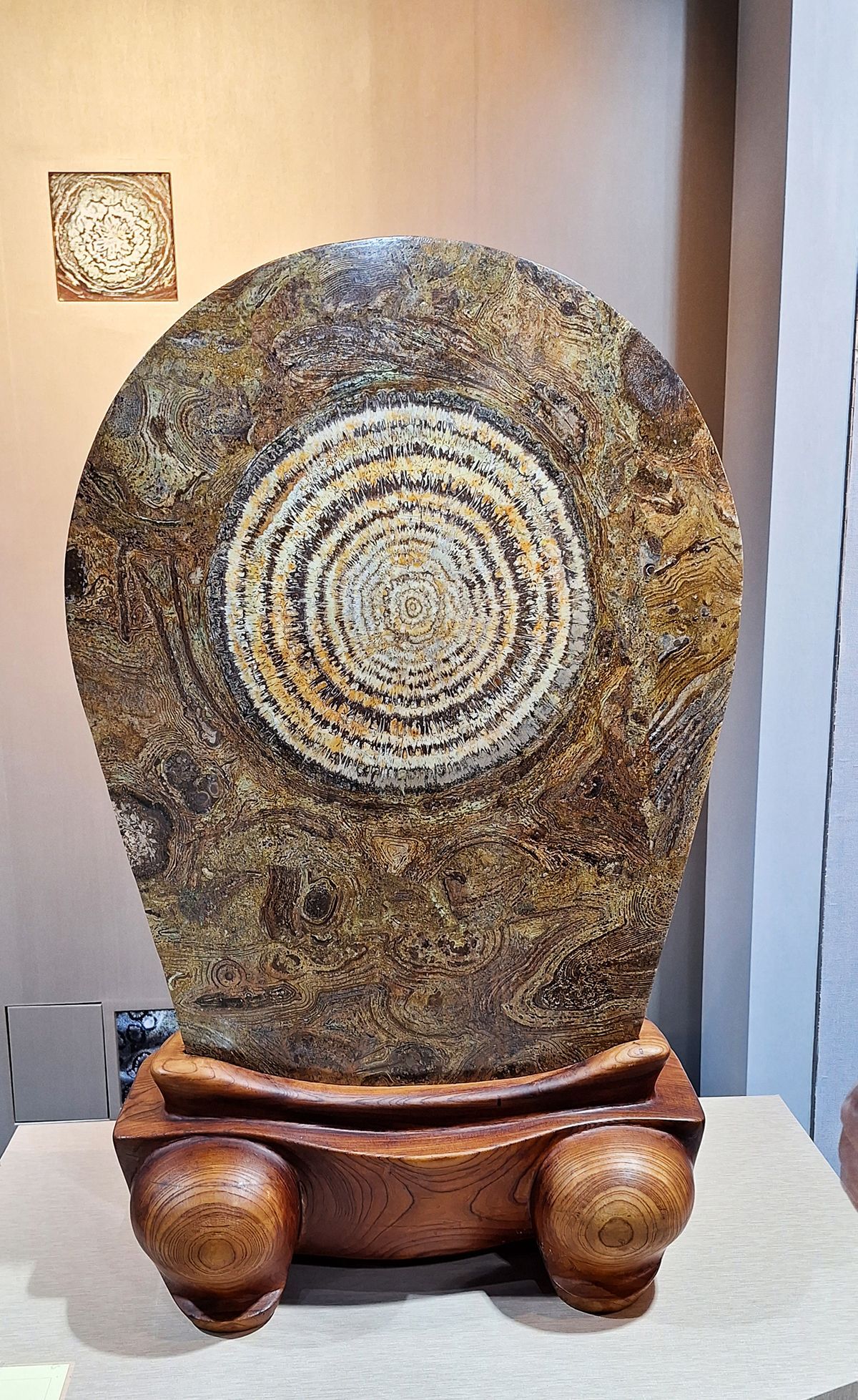
“Sunflower Emperor” is the best-known flower stone in Korea. It is displayed in the Cheongsong Suseok and Flower Stone Exhibition Hall.
The Korean flower-patterned stones are much younger geologically. Studies date these stones to between 48 and 50 million years ago, when molten magma rose to fill cracks and fissures in older, overlying sedimentary rock. Rhyolite was formed as the magma cooled, and small ball-like formations, spherulites, formed within the rhyolite. The flower-like mineral formations formed in the spherulites. Thus, the Korean
Hwamunseok are igneous in nature, rather than the Chinese Juhaushi, which are sedimentary rocks. There are several different mineral patterns seen in the
Hwamunseok. Geologists believe that the different patterns result from the rate at which magma cools. Korean rock collectors have assigned these different patterns to flowers that appear similar. Thus, we have chrysanthemum, rose, sunflower, dandelion, peony, apricot, and others.
These polished stones are displayed on distinct Korean-style carved-wood bases rather than in trays with sand. Unworked Hwamunseok are typically not displayed in exhibitions.
Because of their popularity, there are two museums in South Korea that prominently feature flower-pattern stones. The Cheongsong Suseok and Flower Stone Exhibition Hall and the Cheongcheongbuk Lake Suseok and Flower Stone Exhibition Hall in Jecheon City are both located in South Korea's eastern mountainous region.
The Korean Hwamunseok represents another facet of viewing stone appreciation that should not be overlooked.