
Japanese Tray Landscapes
An introduction to the Japanese Tray Landscapes: Bonseki, Bonkei, and Saikei
By Thomas S. Elias
Displaying a rock or rocks in trays or shallow bowls is perhaps the oldest form of stone appreciation in East Asia. Tray landscape arrangements can be traced to the Tang dynasty (618-907 CE), when tomb murals showed people carrying trays displaying single or multiple rocks. Over time, these tray landscapes incorporated live plants in soil and with miniature figures to create a known or imaginary scene. The introduction of tray and bowl landscape arrangement to Japan is attributed to the late 6th and early 7th centuries, likely through cultural exchange with China and Korea associated with diplomatic missions and Buddhist transmissions.
These three-dimensional, realistic landscape arrangements gave rise to several distinct interpretations that developed into several related but distinct art forms. This illustrates cultural adaptation, where an introduced art form is modified to fit the customs and culture of the receiving country. This article discusses the most commonly encountered types, bonseki, bonkei, and saikei, along with lesser-known forms.
Bonseki and bonkei, along with their variant forms, peaked in popularity during the mid- to late Edo, Meiji, and Taisho periods, but began to decline slowly with the influx of Western art. In the late 20th and 21st centuries, interest in traditional arts and crafts continued to contract. Still, stone enthusiasts should know about this related art form: using stones in tray landscapes.
Bonseki (盆石): Japanese for a tray landscape created on a black tray with small stones and white sand without soil or plants. Bonseki are suitable for display in alcoves, on tables, and in more formal Japanese tokonoma. Zen monk-scholar Kokan Shiren 虎関師錬 (1278–1346) provides evidence of early appreciation for tray landscapes in his classical poem Rhapsody on Bonseki. In this poem, Kokan discusses the pros and cons of plain bonseki versus stones planted with moss or greenery. Several schools of bonseki emerged during its peak in popularity. Today, only one school of bonseki remains in Japan: the famed Hosokawa School of Bonseki in Tokyo.
The term bonseki was used for viewing stones, both single and multiple stone displays, in Japan until the word suiseki began to be used in the Meiji (1869-1912) period. Since that time, suiseki was used for single-stone displays and bonseki for multiple stones forming a scene on a black lacquer tray.
Today, some fine examples of bonseki can be seen at the Japan Suiseki Exhibitions, later renamed the Meihinten, held in the Tokyo Metropolitan Art Museum in the last decade.
Figure 1. Bonseki “Murmuring Garden” displayed by the Hosokawa School of Bonseki at the 2017 Japan Suiseki Exhibition in Tokyo. The principal flat stone (center) is a Tiger-Stripe stone from the Seta River.
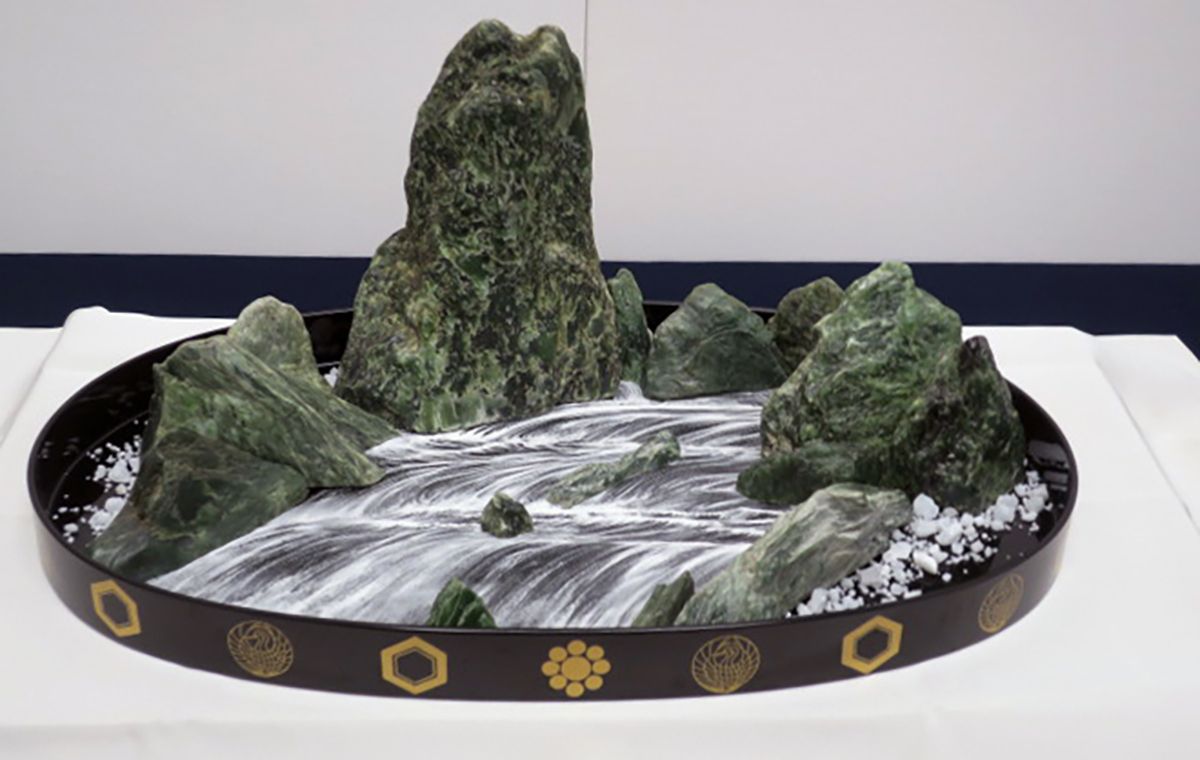
Figure 2. Bonseki “Mountain Stream” displayed by the Hosokawa School of Bonseki at the 2019 Japan Suiseki Exhibition in Tokyo.
Preparing bonseki arrangements involves small feathers and brooms, sieves, a spatula, various-sized small stones, and sand. In modern usage, one defining feature of bonseki is its impermanence, or temporary nature, typically lasting a few days.
Bonkei (盆景) is the Japanese art of creating small-scale landscapes using sand, rock, soil, small living or artificial plants, and miniature objects to represent mountains, rivers, valleys, and scenes (Yanagisawa 1955, Japan Bonkei Association, 1979). It should give the feeling of a realistic landscape. The preferred soil used in tray landscapes is known as keto. It is a dark brown, organic-matter-rich, clay-like soil harvested from wet areas, including the bottom of rice paddies. This muck absorbs and holds water and can be molded to make miniature mountains. Keto’s water-holding properties benefit the health of living plants. Bonkei can be assembled in shallow wood, ceramic, or bronze trays. This form of tray landscape has been present in Japan since the 14th century and became popular in the Edo period (1603—1867) and continued through the Meiji (1868-1912), Taisho (1913-1926), and early Showa beginning in 1930.
Figure 3. Bonkei “Native Place” from Bonkei: Appreciation and How to Make It, page 42.
Over the years, vertical-style bonkei arrangements appeared, expanding the traditional horizontal style. Vertical bonkei are often framed and hung for viewing. These are always dry arrangements. They were popular for a short time in the 20th century but are rarely, if ever, seen today.
Several guides and many illustration manuals were produced during the peak of popularity of bonkei. For example, Morinaga Tatsuo (1935) published Newly Compiled: Three Hundred Varieties of Bonkei, figure 4. This book presents 300 illustrations of suggested landscape arrangements for bonkei students. The Shizan School of Landscape Art used the term bankei (盤景) for its version of bonkei (Ogawa, 1973). Ogawa’s book presents the principles of bonkei (bankei) and a step-by-step guide to making small-scale landscapes. These are just two examples of the many books and manuals published in the 20th century.
Figure 4. “Raft” is illustration #220 in Morinaga’s book of 300 illustrations of bonkei for students to copy in making an actual display.
Japanese publications consistently state that both living and artificial plants may be used in bonkei (Yanagisawa 1955, Japan Bonkei Association 1979). Some modern Internet sources on bonkei contradict the Japanese literature by stating that bonkei uses only dry, non-living materials. But primary sources of information are more reliable.
Bontei (盆庭) (tray garden) was used in the early 20th century for miniature tray gardens using stones, sand, moss, and small living plants arranged to depict a scene in a shallow tray. Tray landscapes should convey the calmness and balance found in large-scale gardens.
Bontei is so similar to bonkei that it should be treated as a subset of it. The term bonkei is older, more common, and more widely used. Illustrations of bontei appear in Nishikawa Issotei’s two-volume Bontei to Bonseki (1936). Figures 5 & 6 were reproduced from this volume.
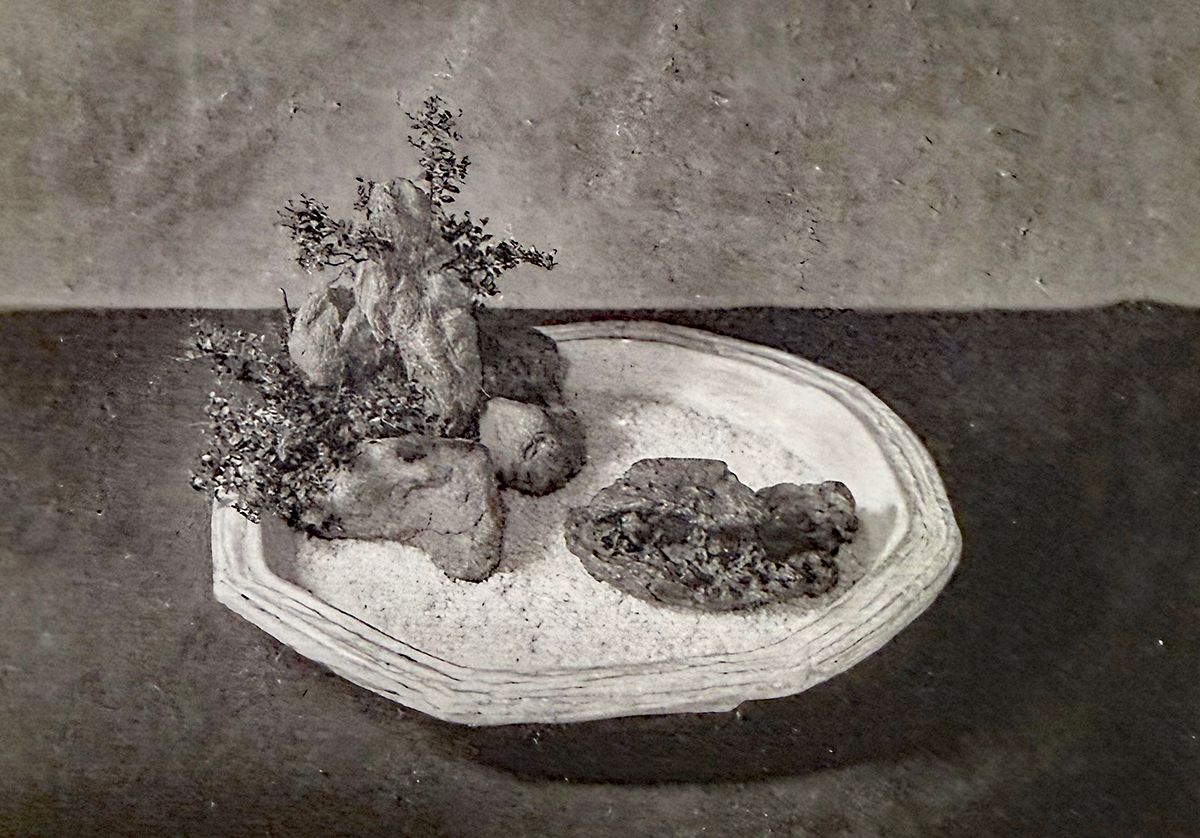
Figure 5. An example of Bontei using stones, plants, and sand, published in Bontei to Bonseki (1936).
Figure 6. A more elaborate bontei illustrated in Nishikawa’s Bontei to Bonseki (1936).
Saikei (栽景): During the difficult economic times in Japan following the end of World War II, Kawamoto Toshio, owner of a bonsai nursery in Tokyo, recognized that people could not afford to buy mature bonsai. He developed a tray landscape using living tree seedlings, rocks, reddish-clay soil, and ground cover plants to create a miniature landscape. He coined the name “saikei” for these tray landscapes. Saikei were initially intended to be short-term, a few-year arrangements that would allow the trees to grow so they could be used as bonsai in the future. Tray landscapes were an inexpensive way to introduce people to bonsai practice. Later practitioners maintained their saikei as long-term tray landscape scenes. Excellent examples are on display at the National Bonsai and Penjing Museum at the U.S. National Arboretum in Washington, D.C.
Figure 7. Some of Kawamoto’s saikei growing on the balcony of his Tokyo apartment in 2000.
Kawamoto established a school in Japan to teach saikei to foreigners, particularly American wives, during the post-war occupation. He also traveled to the United States to lecture and demonstrate his technique. His English-language books,
Bonsai-Saikei: The Japanese Miniature Trees, Gardens, and Landscapes
(1963) and
Saikei: Living Landscapes in Miniature
(1967) helped popularize the art internationally.
Figure 8. A saikei that Kawamoto made in 1973
Figure 9. The same Kawamoto saikei in 1999.
Conclusion
Japanese tray landscapes were influenced by Chinese practices but evolved over time into arrangements that only used small stones, gravel, and sand to create a scene. The introduction of artificial and living plants, including moss, and tiny artifacts (boats, bridges, pagodas, animals) helped create more realistic miniature scenes.
Tray landscape art was once more popular in Japan than suiseki, reflecting their Edo-period taste. Although it declined in the late 20th and 21st centuries, these arts remain important components of East Asian stone appreciation and continue to inform contemporary bonsai, suiseki, and minature landscape practices.
This art form received an additional boost in Western countries with the publication of Lew Buller’s book Saikei and Art, Miniature Landscapes (2005).
References & Additional Reading
Japan Bonkei Association. 1979. Bonkei: Appreciation and How to Make It. Seibundo Shinkosha, Tokyo.
Kawamoto, Toshio & Joseph Y. Kurihara. 1963. Bonsai-Saikei, The Japanese Miniature Trees, Gardens, and Landscapes. Nippon Saikei Company, Tokyo.
_______________. 1967. Saikei: Living Landscapes in Miniature. Kodansha International Ltd., Tokyo.
_______________. 1973. Continued: Design of Trees and Stones, Bonsai and Saikei Techniques. Tsuru-shubo, Tokyo.
Morinaga Tatsuo. 1935. Newly Compiled: Three Hundred Varieties of Bonkei. Kinryudo. Tokyo.
Nishikawa Issotei. 1936. 2 vols. Bontei to Bonseki (Tray Gardens and Tray Stones/Landscapes). Sogensha, Osaka.
Ogawa, Kayo. 1973. Bankei: Its Charm and Techniques, Nichibo Shuppansha Co., Ltd., Tokyo.
Yanagisawa, Soen. 1955. Tray Landscapes (Bonkei and Bonseki). Japan Travel Bureau. Tokyo.
Buller, L. 2005. Saikei and Art, Miniature Landscapes. Privately published. ISBN: 0-9772443-0-X.