
NEWS FROM CANADA
VSANA News 2026
2025 Viewing Stone Displays in Toronto, Canada
by Jeff Shortt
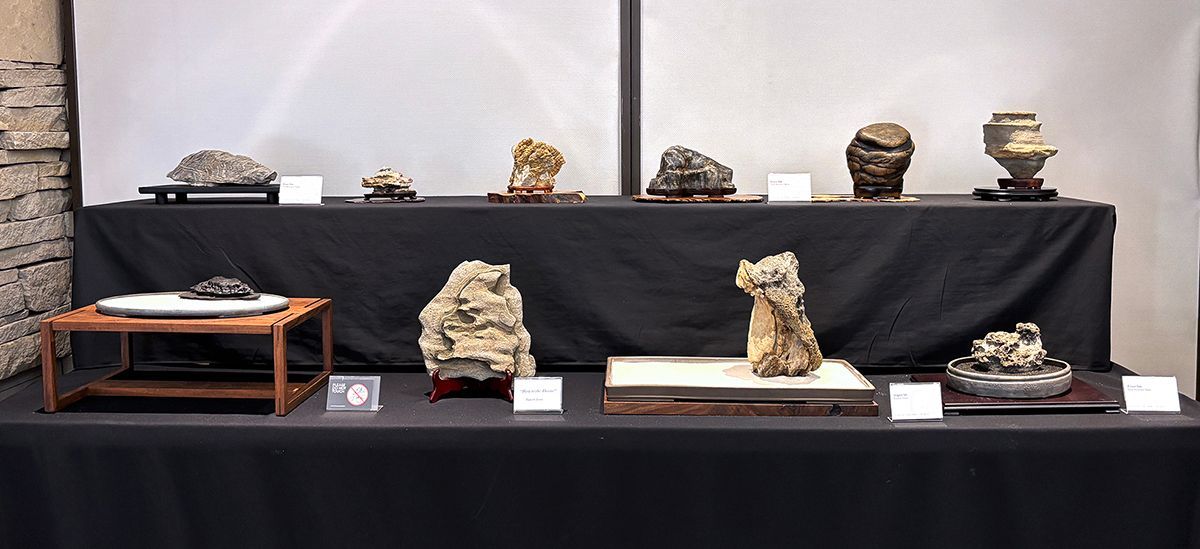
The semi-annual shows of the Toronto Bonsai Society are held at the Toronto Botanical Gardens. This popular spot has regular traffic in gardeners, hikers, photographers, weddings, and various botanical shows throughout the year. Our shows are scheduled for May and October, to take full advantage of the trees in full Spring bloom, or in the spectacular Fall colour for which Canada is famous. Visitors to our shows may come from dedicated Bonsai enthusiasts, or from the public stepping in from the garden paths, taking a break from other exhibits, or running in from a rain shower.
The Society recently celebrated its 60th Anniversary, a testament to the success of our club, and our patrons return regularly to enjoy our efforts and reunite with friends. They have seen the evolution of our bonsai for decades.
What is new to them is the space put aside to display examples from a growing group of stone collectors. Over the past few seasons, interest in stones has grown in the club. The stone enthusiasts have graduated from being politely tolerated to being accepted as an integral part of the club’s persona, and we can assemble a small but respectable display of Viewing Stones, which varies from show to show.
When visitors enter the hall, they are accustomed to the rows of trees through which they can stroll, snapping shots and chatting with the owners and each other. When they come around to the stone display, they approach more cautiously, typically asking: “What ARE these?”
Explaining a Viewing Stone can take time; there are so many aspects to stone appreciation, we could bend their ears for hours, and we often do. But it’s easier to suggest that the stones are talking to them, and to invite them into the conversation. Almost invariably, they take another, longer tour through the display. As they see the personalities of each stone, they begin to grasp the complexity of the art form. Some visitors have turned out to be geologists, and offered keen observations on the different stones - their origins, placement on the Moh’s scale, characteristics regarding patina or surface texture, and so on. These folks are the most fun to converse with, as they have typically studied such material as scientific curiosities, never considering them as art objects.
As with our visitors, the Club’s membership has enjoyed the Stone displays and has come to look forward to the new batch every Show. Almost every meeting has someone bringing in a stone they have found, asking if it has potential or how it might be presented. Their greatest compliment is: “Whenever I went for a walk, I used to look up. Now I look down.”
Agates - The Jewels of Superior (or Lake Superior)
by Jeff Shortt
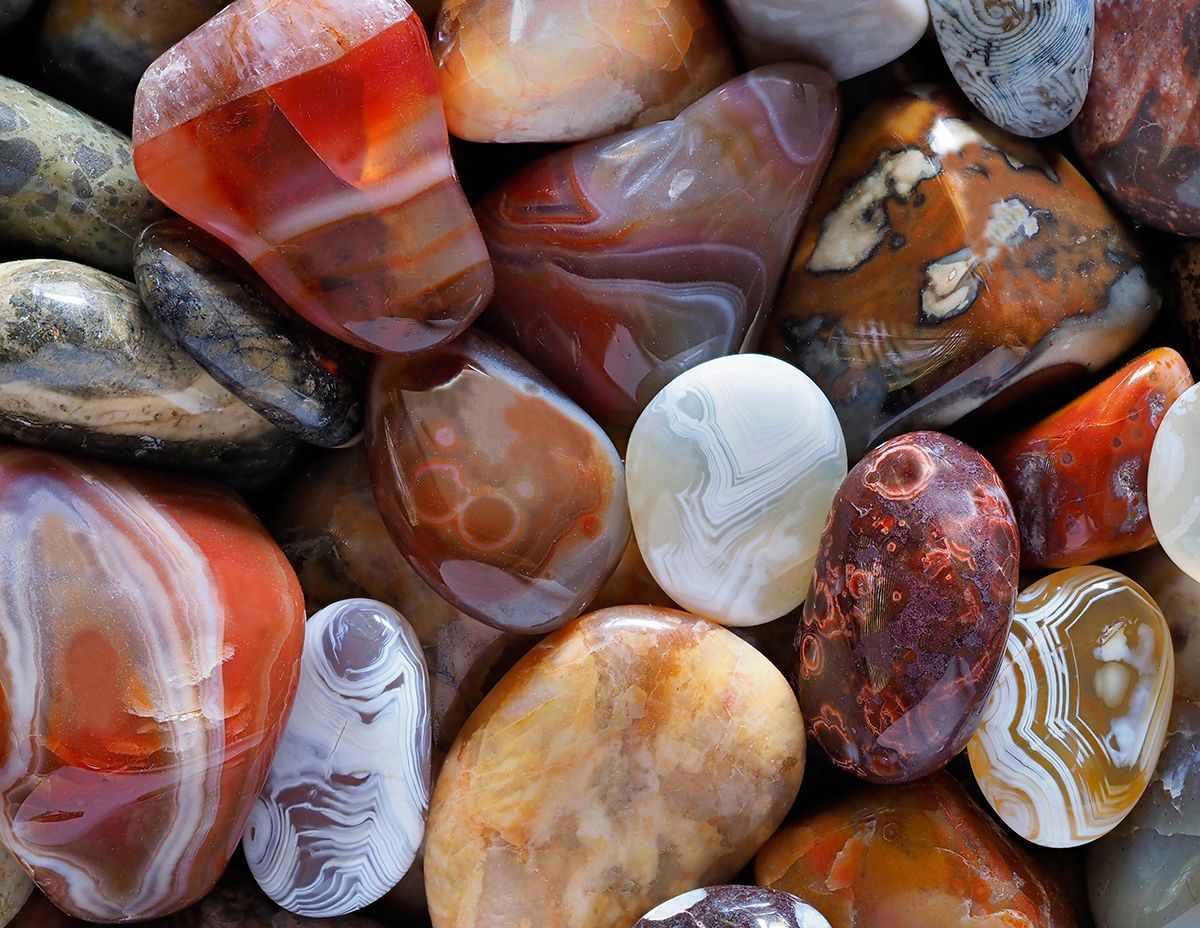
In the centre of North America lie the Great Lakes, the largest freshwater bodies on the planet. Lake Superior, the greatest in volume and depth, holds a treasure trove of agates. These semi-precious stones have been coveted for years for jewelry and other purposes, but they can also be a choice material for viewing stones. Agates typically have striking patterns, bands, or coloration which provide a unique variety to the stones’ surfaces. And Superior has been the perfect breeding ground for them.
Lake Superior shoreline
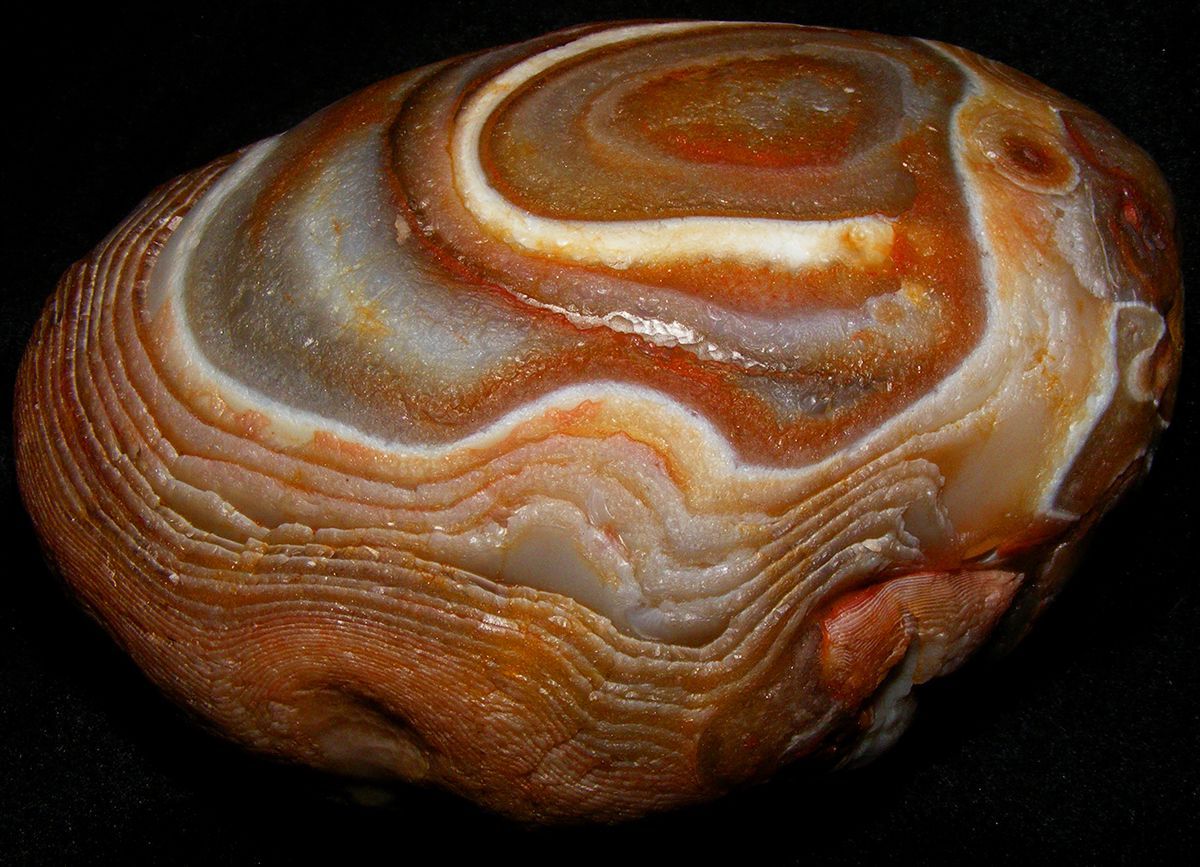
Agates are a variegated form of chalcedony with crystallized quartz formed at the microscopic level. They are formed from lava flows in which, as it settles, gaseous pockets develop. Molten basalt is typically the substrate for the activity. Over time, silica-rich fluids enter these pockets and form micro-crystals coating the sides of the pockets. Different rates of flow and various minerals contribute to a large variety of agates in a wide range of colours. These nodules are typically harder than the substrate and, over time, are exposed as the host material wears away. The agate’s surface can be pitted and scored, retaining the inner contours of the original cavity. Agates can also form within sedimentary rock, including dolomite, sandstone, and limestone, in which organic materials have been cast. As they break down, the silicate materials fill the void.
Similar to agate is jasper, a crypto-crystalline quartz formed at relatively low temperatures (around 200° C). It is formed when silica-rich water filters in through the cracks and pockets of cooling volcanic material. It is found in a variety of colours, although red and green are the most commonly identified.
Why does this region hold such a rich quantity of these treasures? The Great Lakes formed over a billion years ago, when North America began to shift and split, creating the Midcontinent Rift System, and the Canadian Shield was a vast, mountainous lava field. The Superior trough eventually became the basin for the largest of the Lakes. As the basaltic lava cooled, the trapped gases formed vesicles in the rock, initiating the process of agatization.
In more recent times (within the last 100,000 years), a massive glacier known as the Laurentide Ice Sheet covered the entire region. The tremendous pressure of the mile-thick ice ground the surface of the Shield, exposing the hardened agates and depositing them along the region as the glacier receded. Rivers washed the stones down to the shores of the Lakes, particularly Superior.
Viewing stones of agate material are especially noticeable as their glassy textures give them a highly prized patina. Although most of the samples found are naturally tumbled by the Lake’s wave action, occasionally collectors can find one suitable for use as a viewing stone.
VSANA News 2024
October 11-13, 2024
The 60th Anniversary of the Toronto Bonsai Society, one of the oldest Bonsai organizations in North America. Discover 60 years of Bonsai in Toronto at the Toronto Botanical Gardens. An exhibition and sale of some of the finest bonsai, viewing stones, kusamono, and related arts, with guided tours, critiques, workshops, and raffles.
Scheduled guests include William Valavanis from Rochester, New York, Éric Auger and Mariaanne Duhammel from the Montréal Botanical Garden.