
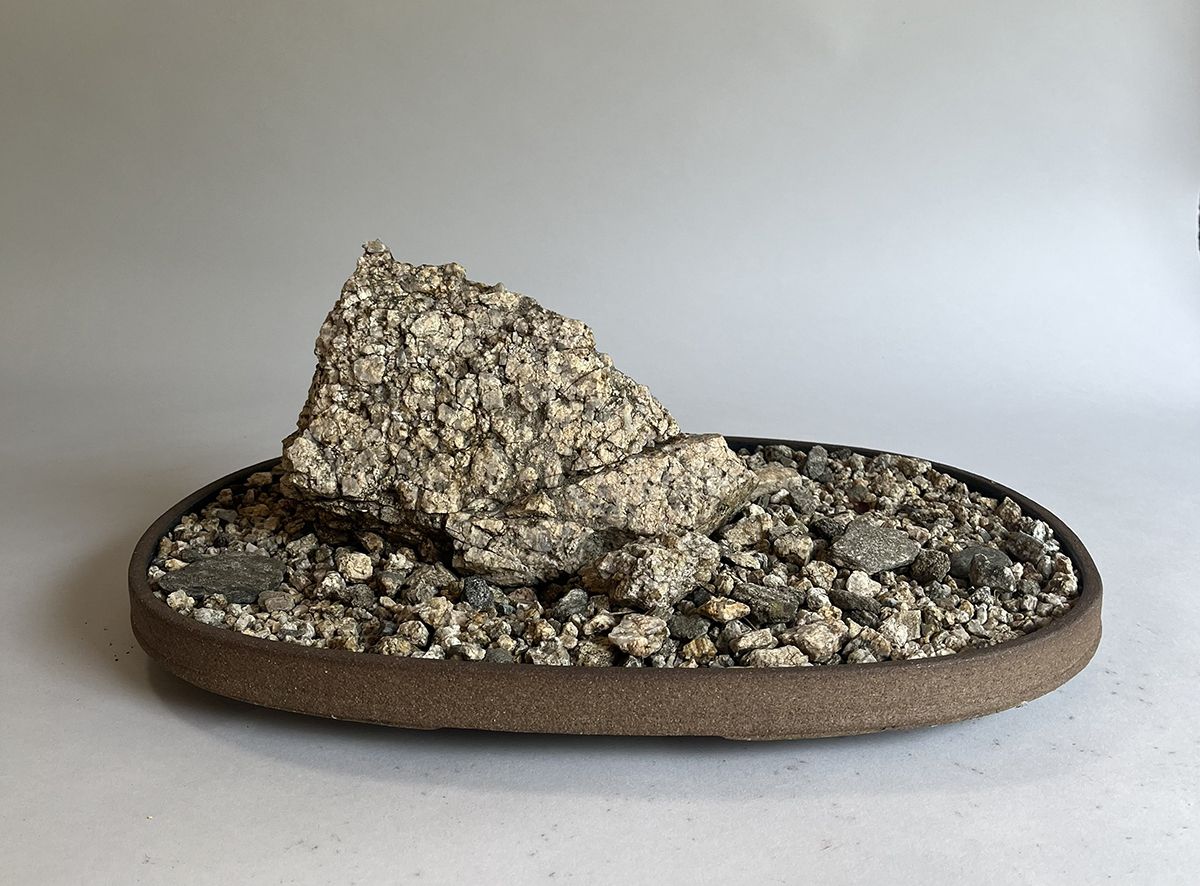
“Dying All The Time”
by Richard Turner
One afternoon, while hiking in the California desert, I stopped to tie my shoe. Kneeling there, I noticed a nondescript piece of granite sunk into the desert floor. The gravel surrounding the stone was clearly the same material as the rock itself, which meant that it had, in all probability, been part of that very stone at some time in the distant past. The stone was disintegrating before my very eyes. This process was occurring at a pace that I could not perceive, but it was happening, nonetheless. The rock was divesting itself of its mass, bit by bit over the millennia, and in doing so, was making a home for itself in the desert floor. The surrounding gravel cradled the stone, accompanying it on its entropic journey towards disintegration.
This experience led me to think about the possibility of the suiban having a different relation to the stone being displayed. Could the area surrounding the stone be more than just a frame? In this display, the decomposed granite is the same material as the stone itself. It extends the stone to the edges of the suiban. And it is more than that: it is a harbinger of the stone’s future.
What stories can you tell with your stones when you activate the space of the suiban in new ways?