
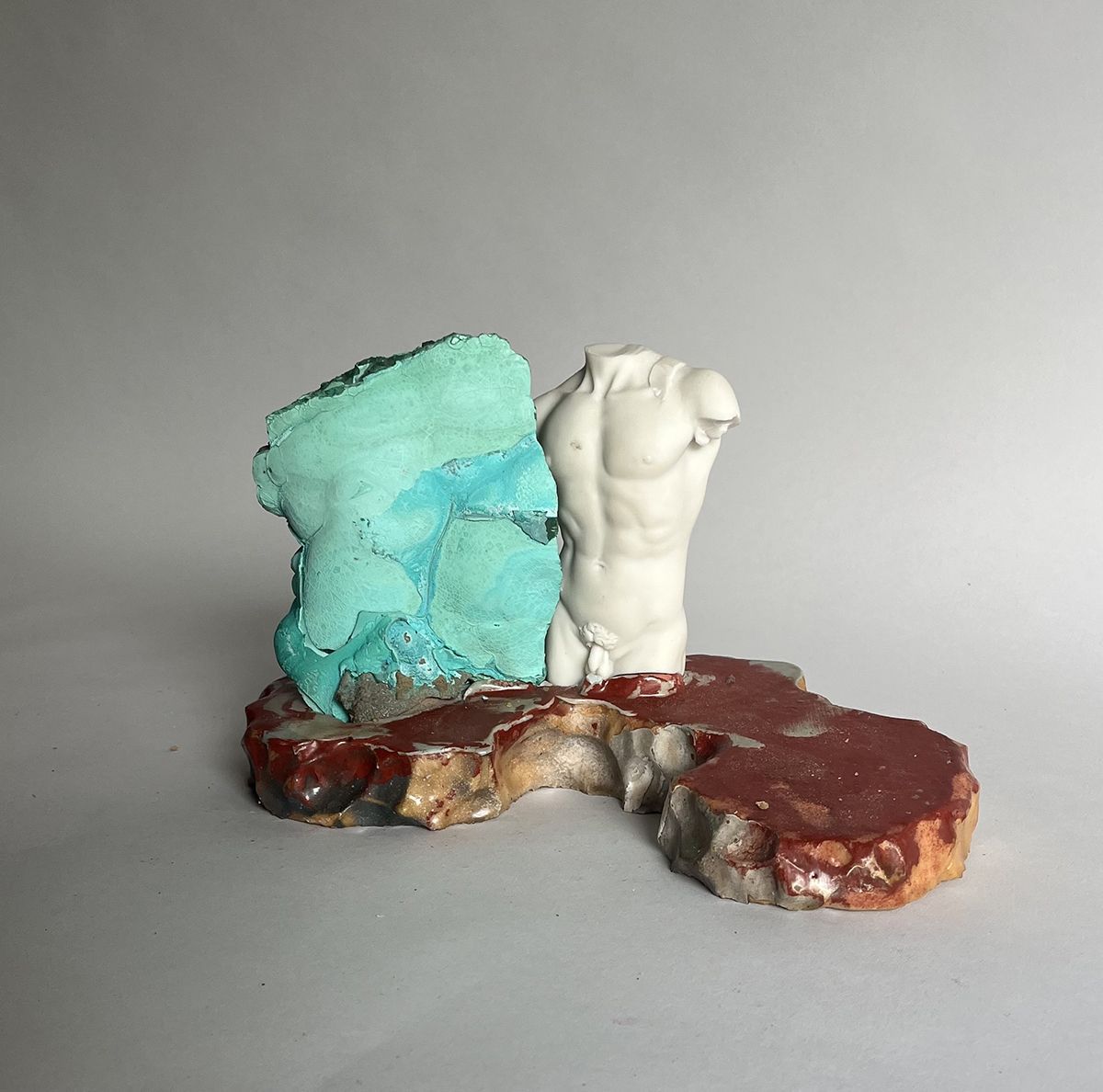
“Untitled”
By Richard Turner
It is common practice to display stones with accompanying objects. We do this because the objects can suggest an approach to a stone that a viewer wouldn’t otherwise consider. A tiny boat floating in the sand of a suiban can transform a stone into an island in the viewer’s imagination. A bronze grasshopper can change the scale of that same stone into a rock in a garden. Accompanying objects and images can suggest a season, reference a poem, allude to time and place or draw our attention to a particular feature of a stone.
In this display, the broken torso of a model of Michelangelo’s iconic sculpture
David is paired with a turquoise fragment in such a way that the viewer is encouraged to understand the mineral as a somewhat abstracted {and larger-scale} fragment of a torso as well. Imagine a figurative sculpture broken off above the abdomen and below the knees. The surface texture of the turquoise fragment and that of the sculpture are similar. The natural undulations of the mineral specimen mirror the musculature of the sculpture. The turquoise specimen may be the torso of a figure rising to a challenge or slumping backward into repose. It might be an athlete or an Amazon. The smooth-textured, more intensely colored portions of the surface might be the remnants of a robe that once draped over the body. This is, admittedly, quite a feat of imagination, but what one sees in a stone is, always, in the mind of the beholder. Without this intimate juxtaposition of the two fragments, the turquoise would remain a mineral specimen and the broken sculpture an unfortunate accident.